Karnataka · South
Durga Temple, Aihole
Durga Devi Temple
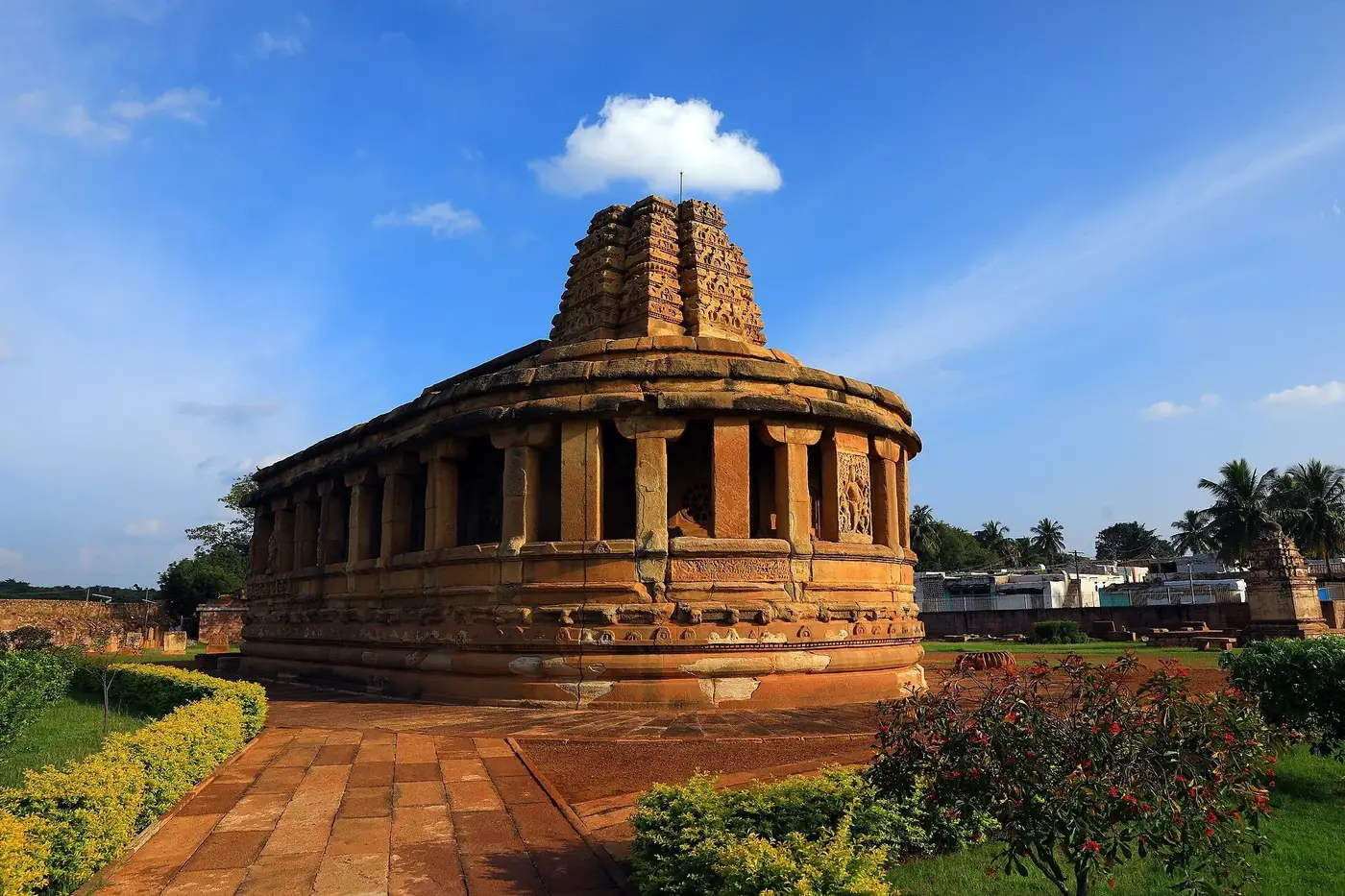
Named not for the goddess but for its proximity to a fort (durg), this 7th-8th century temple at Aihole -- the Chalukyas' earliest architectural laboratory -- is unique for its apsidal plan, a horseshoe form borrowed from Buddhist rock-cut chaitya halls and rare in Hindu temple architecture. A curved ambulatory wrapped by an open peristyle of pillars circles the sanctum, while the sculptural programme on the outer walls captures Chalukya artisans mid-experiment, blending forms that would later mature at Pattadakal. Aihole is often called the 'cradle of Indian temple architecture' for the sheer range of early structural forms tested across its roughly 125 shrines, of which the Durga Temple is the most visited and photographed.
Art & Architecture
- Distinctive apsidal (horseshoe-shaped) plan derived from Buddhist chaitya halls, unique among Hindu temples of the region
- Curved ambulatory passage wrapped by a colonnaded peristyle, an experimental transitional form
- Sculpted panels of Vishnu, Shiva and Durga on the outer walls, transitional in style between Badami and Pattadakal idioms
- Sikhara showing an early, still-evolving Nagara-type tower atop a Dravida-influenced base
Best Season
Festivals
Maha Shivaratri
Journeys Featuring This Temple
Planning your visit
Nearby
Guesthouses and dharamshalas near the temple often take walk-ins. Confirm a single-occupancy rate when you call.
- KSTDC Hotel Mayura Yatri Nivasa212 m
From Overture Maps — not verified by us (2026-08-02)
- OYO Hotel7.6 km
From Overture Maps — not verified by us (2026-08-02)
- Greetoe Resorts9.0 km
From Overture Maps — not verified by us (2026-08-02)
- Jhodpur Vadodara Hotel20.8 km
From Overture Maps — not verified by us (2026-08-02)
- Hotel Badami Court24.1 km
From Overture Maps — not verified by us (2026-08-02)
- Hotel Royal Deluxe Lodge24.1 km
From Overture Maps — not verified by us (2026-08-02)
Listings drawn from third-party maps are not verified by us and may be out of date. Please confirm directly before you travel.
Sources