Craft & Culture
The temple kitchens
Five traditions we can document, and the sources they rest on.
A temple kitchen is not a canteen attached to a monument. At Puri it supports a village of potters; at Udupi it invented a cuisine; at Tirumala it holds a Geographical Indication. What follows is what we can show a source for — no more than that.
01
The Rosha Ghara
In the south-east corner of the Jagannath complex stands a kitchen reported at some 44,000 square feet — thirty-two rooms and around two hundred and forty hearths. Everything cooked in it is cooked in new earthen pots, thrown fresh each day and never used twice, stacked seven to nine high over wood fire so that the steam of the upper pots is the heat of the lower.
Around fifty-six dishes are offered daily to Jagannath, Balabhadra and Subhadra, then sold and eaten at the Ananda Bazaar inside the temple: anna, dali, besara, khechudi, saga, pakhala.
The pots — reported at over fifty thousand a day — come from the Kumbhakara Nijoga potters' society at Kumbharapada, Jenapur, Nuasahi and Tikarapada. The kitchen is therefore not only a kitchen: it sustains a working craft, daily, at a scale nothing else in the country asks of a village of potters.
The kitchen is widely described as the largest in the world. We have not found an authority that establishes it, so we do not repeat it.
Sources: Mahaprasad (Jagannath Temple), Wikipedia · Shree Khetra — the temple kitchen · Shree Khetra — the pots
02
The food you already know
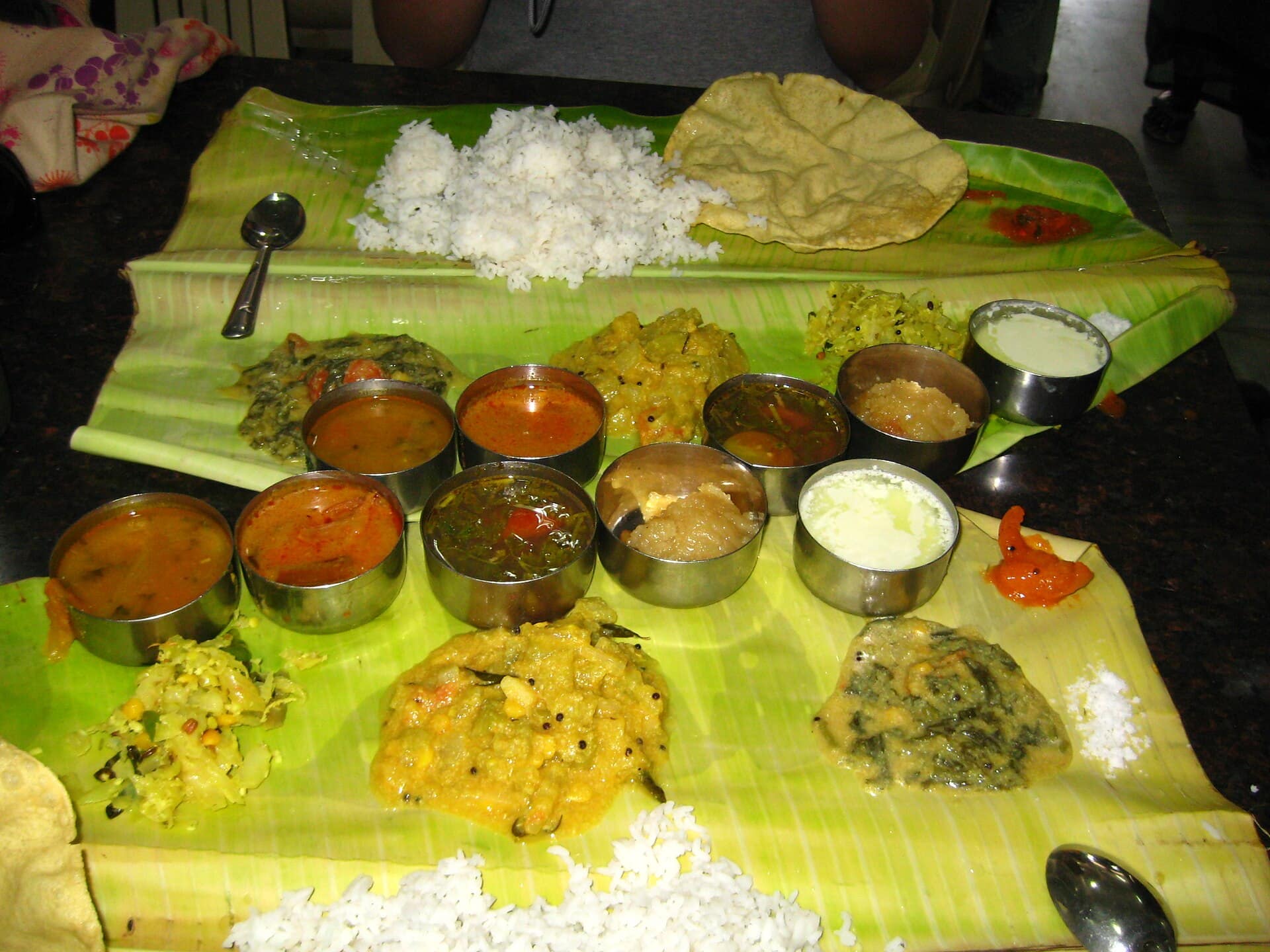
Idli, dosa, vada, upma. Most of what the world calls South Indian food can be traced to one temple kitchen on the Karnataka coast, where Madhva Brahmins developed a cuisine for the specific problem of offering Krishna something different every day. It is strictly sattvic, and traditionally made without onion or garlic.
Shivalli Brahmins carried it outward, and the "Udupi hotel" — cooks trained at the Matha — spread the repertoire across India and then well beyond it.
This is the clearest answer to why temple food should matter to anyone travelling: a temple kitchen invented the food most people think of as South Indian, and it is still cooking.
Sources: Udupi cuisine, Wikipedia · Swarajya — The Story of Udupi Cuisine
03
A sweet with a title deed
The Tirupati laddu holds a Geographical Indication, granted in 2009, which restricts its making to the temple itself. It is one of the few foods in India whose legal identity is bound to a single sanctuary — a laddu made anywhere else is simply not this laddu.
It is made in the Potu, the temple's own kitchen. Daily production figures differ by source and by season: around three hundred thousand, with roughly 1,500 kg of ghee, is commonly reported; other accounts give over three and a half lakh, and up to eight hundred thousand at peak.
We give the range rather than one number, because the sources genuinely disagree and the range is the honest answer.
An adulteration controversy surrounded this laddu in 2024–25. We describe the tradition and its GI status; we make no claims of our own about what is in it.
Sources: Tirupati laddu, Wikipedia · GI filing (origin-gi.com, PDF) · Business Today
04
Annadhanam
From the Thidappally, the kitchen inside the Chuttambalam, Guruvayur serves a free meal each day after the morning poojas — roughly half past ten until half past one. Rice, sambar, avial, pickle, and on some days payasam.
Reported at one to two thousand devotees on an ordinary day, and up to around ten thousand on festival days. It is served free to everyone, regardless of religion or caste.
The same kitchen performs Annaprasanam — Choroonu, a child's first mouthful of rice. A temple that feeds thousands of strangers also marks the first meal of one child at a time.
Sources: Guruvayur Temple, Wikipedia · guruvayurtemple.org — Annadhanam
05
The Ann Kshetra
Somnath's is the newest tradition here, and we would rather say so than dress it as ancient. The Ann Kshetra was proposed in January 2021 and accepted by the Shree Somnath Trust; it is run on the temple premises by volunteers, and the Trust reports around two lakh sixty thousand devotees served.
A separate food donation programme began on 5 November 2021. As at 21 April 2022 the Trust recorded 3.08 lakh people served and food worth Rs. 7.78 crore, provided twice daily, morning and evening.
Those are the Trust's own figures at that date. We have not re-checked them since, and we do not present them as current.
A note
Why only five
Nine of the ten great temple-food traditions belong to sanctuaries we already carry, and it would have taken an afternoon to write a paragraph about each. We stopped at five because five are the ones we could source.
At Dwarkadhish, Kashi Vishwanath and Padmanabhaswamy we found no account of a kitchen or prasadam tradition in any source we opened — which is not the same as saying none exists, only that we will not write one up until we can show you where it comes from. At Meenakshi, a puttu prasadam is described in travel writing we could not verify at source, so it is not on this page either.
The Golden Temple langar at Amritsar is the tenth, and the largest free kitchen of them all. It is Sikh, and outside the scope of what we currently document.
Limited Departures
Join the waiting list for 2027 journeys
Register your interest and our concierge team will be in touch before public release.
Reserve Interest